Introduction
The original specification for the project is found here, for convenience a copy is reported below.
The goal of this sprint is to convert natural language requirements into a machine-readable representation.
A Maritime Cargo shipping company (from now on, simply company) intends to automate the operations of load of containers in the ship’s cargo hold (or simply hold). To this end, the company plans to employ a Differential Drive Robot (from now, called cargorobot).
The hold is a rectangular, flat are a with an Input/Output port (IOPort). The area provides 4 slots to store the containers and a slot named slot5.
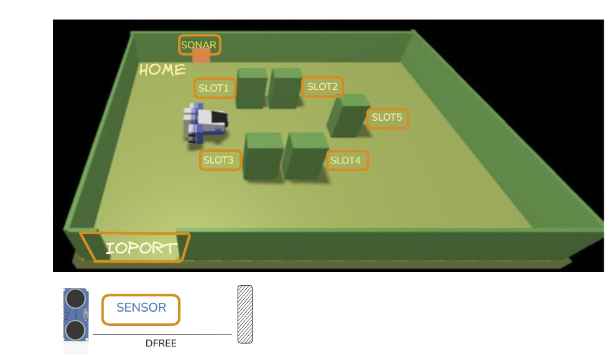
In the picture above:
- The slots1-4 depict the hold areas reserved to store one container each,
- The slots5 depicts an area, where the cargorobot must temporarily store a container, before to place it in one of the slots1-4. During temporary storage, a ‘marker’ device labels the container with an identification barcode and signals when this marking activity is completed.
- The IOPort is a device with a pushbutton and a display. The pushbutton is pressed by the customer in order to to send a request to load a container on the cargo. The display is used to show the answer to the request and to show the current state of the hold.
- The sensor associated to the IOPort is a device (a sonar) used to detect the presence of a container, when it
measures a distance
D, such thatD < DFREE/2, during a reasonable time (e.g.3secs).
Requirements
The company asks us to build service named cargoservice that should work as follows. The cargoservice is able to receive a request to load a container sent by some customer by using the pushbutton of the IOPort.
- It sends the answer
retrylater, if the IOPort is currently occupied by a container or if the system is Out of service - It rejects the request when the hold is already full, i.e. the
slots1-4are already occupied. - Otherwise, it considers the system as engaged, detects a free slot and returns as answer the name of such a reserved slot. While engaged, the system must blink a Led.
When the request to load is accepted, the customer must move the container in the sensor area within prefixed amount of time (e.g. 30 secs), otherwise the systems becomes disengaged. Then, the cargoservice uses the cargorobot to move the container from the IOPort to the slot5 (for marking the container) and then to the reserved slot. The service must also show on the display on the IOPort:
- the current state of the hold
- the message ‘Service working’, when it is all is going well
- the message ‘Out of service’ if the sonar sensor measures a distance
D > DFREEfor at least3secs (perhaps a failure of the sonar).
Requirement Analysis
The system states the presence of a hold which contains slots and an IOPort. Theese objects must me modeled inside the system and will likely be used by the robot to plan its movement across the hold. We begin by defining a slot, it must contain:
- An id to distinguish it (1-5)
- A flag to specify it is currently occupied
public interface ISlot {
    public int getID();
    public boolean isOccupied();
    public void setOccupied(boolean value);
}
The slots are contained in the hold, which also has the IOPort location
public interface IPosition {
    public int getX();
    public int getY();
}

public interface IHold {
    public IPosition getIOPortPosition();
    public IPosition getHomePosition();
    public List<Pair<IPosition, ISlot>> getSlots();
}
Since the hold is rectangular in shape, the reprentation of the map can be a matrix. We choose to make each cell the size of the robot, the position reprents the coordinates of the cell in this matrix. This system can take advantage of the robot’s movement system.
The special slot5 is distinguished by its ID which is always 5.
The cargorobot’s initial position is defined by the HOME position, which is formalized as a special position in the hold obtained by calling the method getHomePosition().
The current requirements do not specify any data about the container, the only information needed is to know if it currently occupied a slot, which can be obtained by the method isOccupied(), so the current system avoids modeling it.
Since the system will be deployed on multiple nodes that are eterogeneous (Raspberry Pico W, a physical robot and a master node) a distributed model based on services is required. Using a general purpose progamming language (such as Java or C#) for this specific use case would force us to writes lots of lines of code and also would be very technology dependent on the chosen communication protocol. For this reasons, our software house has already developed a DSL for this specific purpose: qak. The language is very concise and also supports multiple communication protocols (that will likely be used by the system, like TCP, WebSocket, MQTT) all in a transparent way for the programmer. This makes qak the best choice for this project wherever a service is needed.
The requirements present a message called request to load from the pushbutton to the cargoservice, which is used to start the load process.
Since we want to model the service as a collection of microservices we will the qak language. The message expects an aswer so it will be modeled as a request
Request loadRequest : loadRequest(X)

Reply retryLater : retryLater(RetryMessage) for loadRequest
Reply rejected : rejected(RejectedMessage) for loadRequest
Reply accepted : accepted(SlotID) for loadRequest
The requirements specify that an LED (hardware component which is capable of emitting light) must blink while the system is engaged. The company told us that the chosen LED is going to be the one attached to the Raspberry Pico board.
The system requires us to model the cargorobot, fortunately the software house has previously built a series of components that are used to command a DDR robot, namely:
From the requisites whe can deduce that the robot will:
- Go from home to the IOPort
- Go from IOPort to slot5
- Wait 3 seconds for the marker to finish (the client specified the wait time is fixed)
- Go from slot5 to the reserved slot
- Go back home
Fortunately the implementation RobotSmart26 has a lot of features that the system need already built in, such as:
- A pathfinding algorithm (not present in the others)
- A map based on a grid
- A movement system based on steps of fixed sizes (the cells of the grid)
- It works as a service (not true for RobotObj26, which is a pojo) and it is interactable via qak messages
The IOPort is the component that is used by the client to interact with the system. The company told us that the pushbutton for the IOPort and the display must be a web page that will be used by various users to control the system and watch its status. The page will then need:
- A button that will act as the pushbutton to send the request to load
- At least some string that show the response and the state of the hold
<!DOCTYPE html>
<head>
    <title>IOPort Display</title>
</head>
<body>
    <button>Request to load</button><br>
    Response: <span id="request-result">accepted at hold 1</span><br>
    Current status: <span id="current-status">service working</span>
</body>
</html>
Test Plans
The first component to be tested is the hold, in particular:
- If the hold is empty a request to load should give an accepted response.
- If the hold is full a request to load should give a rejected response.
public class HoldTest {
	private IHold hold = null;
	private static final int width = 8;
	private static final int length = 8;

	@Test
    public void TestEmptyHold() {
        var hold = new Hold();
		assertFalse(hold.getSlots().get(0).component2().isOccupied());
        assertFalse(hold.getSlots().get(1).component2().isOccupied());
        assertFalse(hold.getSlots().get(2).component2().isOccupied());
        assertFalse(hold.getSlots().get(3).component2().isOccupied());
    }

	@Test
	public void TestFullHold() {
        var hold = new Hold();
		for (int i = 0; i < 4; i++) {
        	hold.getSlots().get(i).component2().setOccupied(true);
        }

        assertTrue(hold.getSlots().get(0).component2().isOccupied());
        assertTrue(hold.getSlots().get(1).component2().isOccupied());
        assertTrue(hold.getSlots().get(2).component2().isOccupied());
        assertTrue(hold.getSlots().get(3).component2().isOccupied());
    }
We can also test the request to load, in particular:
- The first request should return accepted
- After all slots have been occupied we should get rejected
QActor ioportmock context ctxcargoservice {
    State s0 initial {
        request cargoservice -m loadRequest : loadRequest(X)
    }
    Transition t0
        whenReply accepted -> s0
        whenReply rejected -> error

    State error {
        println("Test failed, expected accepted reply, got rejected")
    }
}